Sleeping in Haiti is always a challenge for me and many of the team members. The usual travel worries compounded by the excitement of being in Haiti makes it difficult to relax. This trip we were blessedly cooler than in April, with backup generators to power the fans all night. However the roosters in Haiti crow all night. I suppose roosters everywhere crow all night, but I am a city girl and I stupidly believed roasters crow only at dawn. In Montrouis last April the roosters were particularly annoying! But 2 tablets of benadryl and some good ear plugs can block out the crowing pretty well. (Things One Learns to Survive in Haiti).
Not so the dogs. Apparently the "rich, quiet neighborhood" of Village Theodat has it's share of dogs as pets. These are unheard of in most of Haiti. The dogs we have seen before have been cowering, stringy animals who eat out of garbage piles in the street and couldn't manage a loud whimper, let alone a good bark. Chris and Bev have 2 large bull mastiff dogs, whom Sienna called horses, and who became friends with the visitors quickly. Their neighbors also have dogs, and apparently nighttime is their social time. Chris and Bev swore to me it was not their dogs barking, but the other dogs across the street. They bark, says Beverly, at other dogs, at cars going by, at lizards, you name it. Through our bedroom window we heard them, incessantly. Makes a dog lover like me remember a line from the play about Tuna Texas, where Aunt Pearl makes dog treats with her "little strychnine pills" to poison dogs who get into her garden.
Speaking of sleep in Haiti, Bill Squire told me a nice story about being in Haiti 2 days after the earthquake. He somehow used his Episcopal church connections through the Dominican Republic to get transport to the soccer field in Port au Prince where the St Vincent's kids and 3000 other people had evacuated, along with Bishop Duracin. As they were trying to rest that night in their tent, they could hear folks singing hymns all around them until about midnight. Bill told his friend, a dominican priest, that the hymns would start up again about 4 AM. His friend didn't believe him. Sure enough. Bill has always told me that Haitians don't need as much sleep as the rest of the world. I guess they have more time for praising God in difficult circumstances. So when I remember that story and I can't sleep in Haiti, I try to thank God that I am alive and blessed enough to be able to share a little of their lives with these wonderful people.

Sunday, December 12, 2010


The Luxury of Towels
This trip we stayed at a guest house run by Chris and Bev Plourde with Heartline Ministries. Our team is used to staying at St Vincents school with the kids, but the guest quarters were destroyed in the earthquake. We found out about Heartline Ministries through Amy Chanin who worked with them in April 2010. Apparently the guest house is in the former residence of one of the Haitian government ministers who fled the country after the earthquake. It is located In Village Theodat, and appears to be in a rich neighborhood by Haitian standards, (see earlier post).
The house has several large bedrooms which have been converted by putting bunk beds in each one. There are MULTIPLE bathrooms, as opposed to the St Vincents quarters. They had 3 bathrooms but usually only one worked at any given time, which can mean 13 people using one bathroom!
The first indication I had that we had made an UPGRADE in our living accommodations was the piles of clean towels on the counter in every bathroom. I had told everyone to bring an extra bath towel, because I remember using one towel all week last trip and by the end of a sweaty week in Port au Prince, things were getting desperate. Not only were there clean towels at our new guest house; they were washed and replaced daily. Oh my goodness.
The second realization that we were in high cotton was when Chris came into our bedroom as we were getting ready for bed, bringing extra fans. He told me he wanted to make sure each bed had it's OWN FAN. Now those of you who went to Montrouis with us in April remember sleeping in a room with 5 people and one fan, which turned off at midnight when the generator turned off. I just couldn't believe the blessing. Jill Bullard and I agreed we were in the Haiti Hilton. They even have laundry service for $5 per week. Of course my friend Sherye aptly pointed out that one of the things you give up in Haiti is your personal privacy. When you pick up your clean laundry in the morning you must sort through ALL the clean laundry to find yours. Boxers size 36, anyone?
Susan Nelson
The house has several large bedrooms which have been converted by putting bunk beds in each one. There are MULTIPLE bathrooms, as opposed to the St Vincents quarters. They had 3 bathrooms but usually only one worked at any given time, which can mean 13 people using one bathroom!
The first indication I had that we had made an UPGRADE in our living accommodations was the piles of clean towels on the counter in every bathroom. I had told everyone to bring an extra bath towel, because I remember using one towel all week last trip and by the end of a sweaty week in Port au Prince, things were getting desperate. Not only were there clean towels at our new guest house; they were washed and replaced daily. Oh my goodness.
The second realization that we were in high cotton was when Chris came into our bedroom as we were getting ready for bed, bringing extra fans. He told me he wanted to make sure each bed had it's OWN FAN. Now those of you who went to Montrouis with us in April remember sleeping in a room with 5 people and one fan, which turned off at midnight when the generator turned off. I just couldn't believe the blessing. Jill Bullard and I agreed we were in the Haiti Hilton. They even have laundry service for $5 per week. Of course my friend Sherye aptly pointed out that one of the things you give up in Haiti is your personal privacy. When you pick up your clean laundry in the morning you must sort through ALL the clean laundry to find yours. Boxers size 36, anyone?
Susan Nelson
Re-Entry
Coming back to my American life after a trip to Haiti is always difficult. It has been a week now since we landed in Memphis and had to put on warm winter coats, shocked at the temperature change. My daughter walked around the first few days wrapped in a blanket complaining, "it's cold in this country!"
Returning to work, I would manage to finish the day, come home and fall asleep in my food at the dinner table. I wanted to post my photos, write stories for the blog, tell everyone about our experience. But sleeping from 8 pm til 6 am cuts out a lot of free time!
Finally Saturday morning I awoke feeling a little more energy. Managed to have a conference call with some very nice folks from Red Thread Promise (check them out on the web) who want to help rebuild St Vincents and have already sent a shipment of wheelchairs to Haiti. Of course their container is still sitting on the dock; I could have told them we know all about that!
Also long talk with Margaret McLaughlin yesterday, who went with us to Montrouis in April and has a continuing correspondence with Jonas at St Vincents. Margaret describes their conversations in French over the phone; you can imagine some of those difficulties. Can you hear me? Yes. Repeat. Are you there. Yes. Repeat, louder this time. Apparently Margaret's husband can tell when she is on the phone to Haiti because he can hear her shouting. In French.
So i send my apologies to all of you who want to hear about our trip. I promise to stay up past 8:30 pm this week and get my photos into the blog. Thanks to all of you for your prayers which protected us while we were there. Our children looked safe and healthy and happy.
Susan Nelson
Returning to work, I would manage to finish the day, come home and fall asleep in my food at the dinner table. I wanted to post my photos, write stories for the blog, tell everyone about our experience. But sleeping from 8 pm til 6 am cuts out a lot of free time!
Finally Saturday morning I awoke feeling a little more energy. Managed to have a conference call with some very nice folks from Red Thread Promise (check them out on the web) who want to help rebuild St Vincents and have already sent a shipment of wheelchairs to Haiti. Of course their container is still sitting on the dock; I could have told them we know all about that!
Also long talk with Margaret McLaughlin yesterday, who went with us to Montrouis in April and has a continuing correspondence with Jonas at St Vincents. Margaret describes their conversations in French over the phone; you can imagine some of those difficulties. Can you hear me? Yes. Repeat. Are you there. Yes. Repeat, louder this time. Apparently Margaret's husband can tell when she is on the phone to Haiti because he can hear her shouting. In French.
So i send my apologies to all of you who want to hear about our trip. I promise to stay up past 8:30 pm this week and get my photos into the blog. Thanks to all of you for your prayers which protected us while we were there. Our children looked safe and healthy and happy.
Susan Nelson
Saturday, December 11, 2010
The Patience of Job
That’s what comes to my mind as we travel in the back of the small pickup truck we travel for miles and miles and as far as my eye can see there is tent after tent one on top of the other siting out in the flood plain barely a path between them. My eyes tear up as I tell myself we have seen them before last April and there is no noticeable change except most now have tarps draped over them because they must leak. I have had to do the tarp thing over the tent because of leaking and the problem with doing that is you just made yourself a new sauna they tent no longer breaths and the heat in it just builds and builds. I honestly can’t imagine how hot it must get in that tent in the summer last April I visited the tent city and it felt as if I was in an oven and that wasn’t the hottest? How does a father protect his family while living in a tent? The thought crossed my mind as we drove by this and that was, if we were in America and we had dogs outside tied up and lived like this the Animal Control would come by and take the animals away. How do we help our friends here in Haiti how can the aide money be tied up in Congress may be the senator should spend some time in the tent city? These tent cities are a stop gap measure at best and only for a short term we, are coming up on a year and have yet seen any significant improvement. We have to do better we are all God’s children the People of Haiti have shown restraint and patience it has to be changed before it explodes. Please God help us and them we must do better.
sent in by John Mutin
Tuesday, December 7, 2010

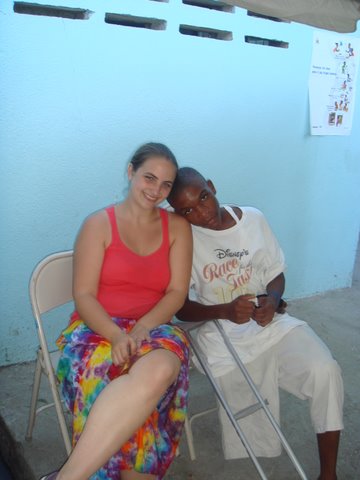
Photos from St. Vincent's Trip Dec 2010
 Here are a few photos from the Dec. trip.
Jill Bullard holds Viki Vincent, an infant boy with club feet and the newest orphan adopted by St. Vincent's School. He was baptized during our December trip.

Sherye Fairbanks and Jean Robert
Sunday, December 5, 2010
Sherye's journal from December 2010
Haiti Journal
November 2010
My dear friends,
It was impossible to get access to a computer every night, so I wrote everything but the first paragraph when we returned on December 5. Enjoy!
November 27:
We have arrived safely. Words cannot describe the drive from the airport to the house we are staying at. No lanes on the road and all the drivers are playing chicken! We are sooooo grateful to be alive after the drive here. Our first surprise was getting off the airplane and on the open-air shuttle. Half way across the tarmac our driver slowed down and pointed to the left. Sean Penn was standing there! More tomorrow if I can get to a computer.
December 5:
About Sean Penn—He has built a hospital here on what used to be a golf course before the earthquake. He hires Haitian workers and they are trained to be assistants in medical facilities. There have been a few times when he has flown patients out of Haiti in emergencies on his plane. He uses his own money and some donations. The Haitian people seem to really appreciate what he does.
I was relieved to find that there was an internet connection at the guesthouse and it would be possible to communicate with you all, but Haiti has its own rules and way of doing things and that was only possible one time. After the first night, we lost internet and electricity most evenings, making it difficult. This will be a long letter to you all to play catch-up. We were staying at a guesthouse that those in our group who had made this trip before called the “Haiti Hilton” because it was so much nicer than the place they stayed last time. This included a generator for emergency use when we lost electricity.
I found that the thing I missed the most about nights without electricity was that it interfered with taking a shower because of the water pumps that ran the well. We did figure out that if we all cooperated, there was enough water for everyone to take a shower. First you turn on the water, get wet, turn it off, soap up, and turn it on again to rinse off really quickly!! That way we all got that much needed and much desired shower. One of the most important things for us all was to cooperate and behave as a group. This was necessary not only to get things done, but to stay safe.
On Sunday, our first full day, we stayed at the guesthouse and organized all the medicine and supplies. There was a genuine scare about our safety because of the elections. The schools and most businesses were closed and what we thought were crowded streets were actually pretty sparse. Many people stayed home during and a few days after the election.
On Tuesday we were able to get to St. Vincent’s. Imagine if you will 10 adults crowded (and I do not use the word “crowded” lightly!) into the back of a pick-up truck and traveling through the streets of Port au Prince. You cannot believe how dusty the streets were. We were no more crowded than anyone else traveling, but everything about us screamed American! Our clothes, our skin color—most of us were white--our hats, our haircuts, and especially our size. Most of the people in Haiti are desperately thin. We were not.
Upon arriving we managed to untangle ourselves and were greeted by smiling faces, hugs, and many, many “bon jour’s!” Kids were jumping up and down and dancing around. The craziness of just getting to Haiti and then to the orphanage, was all worth it at this moment.
We eventually set up the clinic in a Quonset hut and saw about 30 patients that day. I was the interpreter for the deaf who sign a combination of about 80% American Sign Language and 20% something else that I could not identify. That was enough to communicate pretty well. The doctors were remarkable. We were in a room measuring about 15’ by 15’. In this hut there were 2 doctors, 3 interpreters (1 for sign language to spoken English and 2 for Haitian Creole to English), 2 chairs for the patients (the doctors and interpreters rarely sit down), 2 tables covered with sheets used for examination tables, a small table to hold the supplies which included suckers to give out to each patient (these are as important to the adults as they are to the children!), a screen covered with a white sheet to separate the tables, 2 fans on stands, several extension cords, 1 trash can, and 2 patients. And no one complains.
The patients wait outside in the heat until they are called. Everyone gets a hematocrit to determine if they are anemic—which they quite often are. Everyone gets weighed and their blood pressure is measured. These stations are set up outside. After all this, the patients walk over to the “pharmacia” to get any medicine that has been prescribed. This is actually the front of the director’s office. The books have been taken off the shelves so we can use the space for supplies, which means that the director is relegated to a space behind the bookshelves barely big enough for his desk. He does not complain and is truly more than willing to allow us this space. We were lucky enough to have a real live pharmacist come with us on this trip and she sat at a small table labeling the containers and measuring out pills and medicine. One of the students who speaks pretty good English helped write directions on the labels in Creole. She has no arms so she writes with her right foot. I dare say her handwriting is more legible than most in our group! No one complains.
The whole process for 30 patients lasts about 5 hours. It is around 100 degrees in the tent and hotter out in the sun and no one complains. The range of problems was enormous. Some were simple and others would break your heart.
There is no telling what is required of anyone. Everyone must be flexible and willing to do whatever is needed at any specific moment. The doctors take out the trash, the interpreters carry babies where they need to be, and running over to the pharmacy can be anyone’s job. There is great effort made to make the process as efficient as possible, but we try to stop each time and greet the patients and there is a great deal of laughter and smiling. When there is a problem, something doesn’t work, or there is confusion, you just stay calm, smile, and fix it. No one complains.
Every day after clinic was over we went out and played with the kids for a couple of hours. This is an orphanage for handicapped children. The ages are from about 6 to 19, but there are 2 babies that were abandoned there that are taken care of. They all have some handicap—deaf, blind, missing limbs, cerebral palsy, the list goes on. But when you look at this group of children you really see just children. They play and are happy and tease each other like all kids do. In some manner or the other, they are mostly all mobile and laugh a lot. They love to sing and dance. Music is everywhere. The teenagers are like all teenagers. They are trying to be cool and the boys are interested in the girls and the girls are interested in the boys.
Most of the time, our driver was Renauld. At first we thought all Haitian drivers were terrible, but came to realize that they were actually extremely good. There is not enough room for all the cars. Being in the back of the truck gave us a whole new perspective on traffic in Port au Prince. One inch space from the vehicle next to you on either side was enough. Passing, when possible, put you close enough to swap spit with the person in the next car. No one complains, but a lot of people honk their horns!
Renauld is a hero to those in the orphanage. When the earthquake hit, he went back into the shaking and collapsing buildings and brought out many of the children who could not walk because of their handicaps. He went back several times and saved many of the children who might have died in the falling rubble. There are so many stories like this one--stories of people who just performed these incredible acts of bravery and are quite humble about it. Renauld says that he believes God put him in that place on that day to “help get the children out.” I am honored to know him.
Wednesday and Thursday we moved the clinic to a building built for the orphanage by the A.A.R. This is, I think, the Association for Aid and Relief, an organization based in Japan. The story is that they came to Haiti after the earthquake and found out about the destruction at St. Vincent’s Orphanage. (What was not completely destroyed was completely looted.) They came and asked how they could help. They had an engineer and wanted to build a clinic. This is such luxury for the doctors who are used to having 2 examining tables with a sheet hung to divide them. They still share one examining room, but there is more space and the patients can wait inside for their turn. There is also a bathroom at the end of the short hallway and a small room with upper shelves and lower cabinets that will become the new “pharmacia.”
Friday was a very special day. We were honored to be there at their annual celebration of St. Vincent, the patron saint of the handicapped. There was a lot of singing and dancing. It opened with a prayer service. The AAR was honored, as was our group. The new clinic was dedicated, even though we had already used it! The kids all ate a great lunch with rice and sauce, a chicken leg, a vegetable, and cake. This is a special meal. Usually they eat rice with Haitian peas or some kind of bean, or sometimes rice with some kind of sauce on it for flavor. They normally eat 2 meals a day. Each child got a stuffed animal. We brought the animals, so those of you who donated to this trip helped to pay for them! Merci!
The evenings were calmer back at the guesthouse. As one large group, and in smaller groups of 2 or 3, we talked about the things that happened each day. The things that touched our hearts and the things that made us laugh. This is very productive. It keeps you sane and it is interesting to get the perspective of each person. We all come from different backgrounds and are different ages. One of the doctors was 88 years old. She is from Holland and was in Europe during WWII. She compared the destruction that you see everywhere in Haiti to that in Europe after the war. I have only seen pictures of Europe after WWII, but I think her point is well taken.
If I had to use only one word to describe Haiti, I would have to say it would be “dignity.” On Wednesday when we arrived all the children were dressed for their school day. This is cultural. They were wearing cotton uniform shirts that were ironed!! (I don’t iron!) Their hair was all combed and put up. The teachers and other people who work there all wear clean ironed shirts and pants or dresses. The children shower every day and their clothes are washed by hand by 3 ladies with wash tubs and hung on a clothes line to dry, then the uniforms are ironed. They are proud and dignified, and they are very humble. And they do not complain. The other word I would choose is “polite.”
Jean Robert was our guide and took great care of us. He is what you might call the grounds keeper for the orphanage, although he has more than one job there. He also helps to make sure the children are alright and that they behave and are polite. He invited us to visit his very small house which was condemned after the earthquake. He and his family sleep in one of the many tent cities we saw. He is in charge of three tent cities and manages them well. The most amazing thing we did was to take a tour through one of these tent cities which is a short walk from the orphanage. This is a memory I will never be able to let go of. Everyone was polite and nodded to us and to Jean Robert as we walked past. He is very well respected there. They said “bon jour” and smiled. It was very touching that in this unbelievably poor place, people are managing to raise their children and sleep in conditions that I find indescribable. There are no words. If there are words, I don’t know them. And they grow potted plants. I believe this to be a sign of hope. Anyone who feels hopeless does not take care of a potted plant.
After 6 days I was as tired as I have ever been. Leaving was joy and heartbreak at the same time. When we boarded the truck on Friday to leave for the last time, I cried. The children were waving and pretending to take pictures of us—a way of teasing those of us who took pictures of them the whole time! It was an incredible relief to arrive in Memphis after 13 hours on planes and in airports and see my husband waiting for me. At the same time it was incredibly sad to leave the kindness of the Haitian people, the laughing crickets and starry nights (there are no lights to get in the way of the stars) and these beautiful children.
We do what we can. We cannot do it all. We did the best we could with each person who came to us. We tried not to complain. Thank you to everyone who was kind enough to help and for the many, many prayers. I felt them all.
Sherye’
November 2010
My dear friends,
It was impossible to get access to a computer every night, so I wrote everything but the first paragraph when we returned on December 5. Enjoy!
November 27:
We have arrived safely. Words cannot describe the drive from the airport to the house we are staying at. No lanes on the road and all the drivers are playing chicken! We are sooooo grateful to be alive after the drive here. Our first surprise was getting off the airplane and on the open-air shuttle. Half way across the tarmac our driver slowed down and pointed to the left. Sean Penn was standing there! More tomorrow if I can get to a computer.
December 5:
About Sean Penn—He has built a hospital here on what used to be a golf course before the earthquake. He hires Haitian workers and they are trained to be assistants in medical facilities. There have been a few times when he has flown patients out of Haiti in emergencies on his plane. He uses his own money and some donations. The Haitian people seem to really appreciate what he does.
I was relieved to find that there was an internet connection at the guesthouse and it would be possible to communicate with you all, but Haiti has its own rules and way of doing things and that was only possible one time. After the first night, we lost internet and electricity most evenings, making it difficult. This will be a long letter to you all to play catch-up. We were staying at a guesthouse that those in our group who had made this trip before called the “Haiti Hilton” because it was so much nicer than the place they stayed last time. This included a generator for emergency use when we lost electricity.
I found that the thing I missed the most about nights without electricity was that it interfered with taking a shower because of the water pumps that ran the well. We did figure out that if we all cooperated, there was enough water for everyone to take a shower. First you turn on the water, get wet, turn it off, soap up, and turn it on again to rinse off really quickly!! That way we all got that much needed and much desired shower. One of the most important things for us all was to cooperate and behave as a group. This was necessary not only to get things done, but to stay safe.
On Sunday, our first full day, we stayed at the guesthouse and organized all the medicine and supplies. There was a genuine scare about our safety because of the elections. The schools and most businesses were closed and what we thought were crowded streets were actually pretty sparse. Many people stayed home during and a few days after the election.
On Tuesday we were able to get to St. Vincent’s. Imagine if you will 10 adults crowded (and I do not use the word “crowded” lightly!) into the back of a pick-up truck and traveling through the streets of Port au Prince. You cannot believe how dusty the streets were. We were no more crowded than anyone else traveling, but everything about us screamed American! Our clothes, our skin color—most of us were white--our hats, our haircuts, and especially our size. Most of the people in Haiti are desperately thin. We were not.
Upon arriving we managed to untangle ourselves and were greeted by smiling faces, hugs, and many, many “bon jour’s!” Kids were jumping up and down and dancing around. The craziness of just getting to Haiti and then to the orphanage, was all worth it at this moment.
We eventually set up the clinic in a Quonset hut and saw about 30 patients that day. I was the interpreter for the deaf who sign a combination of about 80% American Sign Language and 20% something else that I could not identify. That was enough to communicate pretty well. The doctors were remarkable. We were in a room measuring about 15’ by 15’. In this hut there were 2 doctors, 3 interpreters (1 for sign language to spoken English and 2 for Haitian Creole to English), 2 chairs for the patients (the doctors and interpreters rarely sit down), 2 tables covered with sheets used for examination tables, a small table to hold the supplies which included suckers to give out to each patient (these are as important to the adults as they are to the children!), a screen covered with a white sheet to separate the tables, 2 fans on stands, several extension cords, 1 trash can, and 2 patients. And no one complains.
The patients wait outside in the heat until they are called. Everyone gets a hematocrit to determine if they are anemic—which they quite often are. Everyone gets weighed and their blood pressure is measured. These stations are set up outside. After all this, the patients walk over to the “pharmacia” to get any medicine that has been prescribed. This is actually the front of the director’s office. The books have been taken off the shelves so we can use the space for supplies, which means that the director is relegated to a space behind the bookshelves barely big enough for his desk. He does not complain and is truly more than willing to allow us this space. We were lucky enough to have a real live pharmacist come with us on this trip and she sat at a small table labeling the containers and measuring out pills and medicine. One of the students who speaks pretty good English helped write directions on the labels in Creole. She has no arms so she writes with her right foot. I dare say her handwriting is more legible than most in our group! No one complains.
The whole process for 30 patients lasts about 5 hours. It is around 100 degrees in the tent and hotter out in the sun and no one complains. The range of problems was enormous. Some were simple and others would break your heart.
There is no telling what is required of anyone. Everyone must be flexible and willing to do whatever is needed at any specific moment. The doctors take out the trash, the interpreters carry babies where they need to be, and running over to the pharmacy can be anyone’s job. There is great effort made to make the process as efficient as possible, but we try to stop each time and greet the patients and there is a great deal of laughter and smiling. When there is a problem, something doesn’t work, or there is confusion, you just stay calm, smile, and fix it. No one complains.
Every day after clinic was over we went out and played with the kids for a couple of hours. This is an orphanage for handicapped children. The ages are from about 6 to 19, but there are 2 babies that were abandoned there that are taken care of. They all have some handicap—deaf, blind, missing limbs, cerebral palsy, the list goes on. But when you look at this group of children you really see just children. They play and are happy and tease each other like all kids do. In some manner or the other, they are mostly all mobile and laugh a lot. They love to sing and dance. Music is everywhere. The teenagers are like all teenagers. They are trying to be cool and the boys are interested in the girls and the girls are interested in the boys.
Most of the time, our driver was Renauld. At first we thought all Haitian drivers were terrible, but came to realize that they were actually extremely good. There is not enough room for all the cars. Being in the back of the truck gave us a whole new perspective on traffic in Port au Prince. One inch space from the vehicle next to you on either side was enough. Passing, when possible, put you close enough to swap spit with the person in the next car. No one complains, but a lot of people honk their horns!
Renauld is a hero to those in the orphanage. When the earthquake hit, he went back into the shaking and collapsing buildings and brought out many of the children who could not walk because of their handicaps. He went back several times and saved many of the children who might have died in the falling rubble. There are so many stories like this one--stories of people who just performed these incredible acts of bravery and are quite humble about it. Renauld says that he believes God put him in that place on that day to “help get the children out.” I am honored to know him.
Wednesday and Thursday we moved the clinic to a building built for the orphanage by the A.A.R. This is, I think, the Association for Aid and Relief, an organization based in Japan. The story is that they came to Haiti after the earthquake and found out about the destruction at St. Vincent’s Orphanage. (What was not completely destroyed was completely looted.) They came and asked how they could help. They had an engineer and wanted to build a clinic. This is such luxury for the doctors who are used to having 2 examining tables with a sheet hung to divide them. They still share one examining room, but there is more space and the patients can wait inside for their turn. There is also a bathroom at the end of the short hallway and a small room with upper shelves and lower cabinets that will become the new “pharmacia.”
Friday was a very special day. We were honored to be there at their annual celebration of St. Vincent, the patron saint of the handicapped. There was a lot of singing and dancing. It opened with a prayer service. The AAR was honored, as was our group. The new clinic was dedicated, even though we had already used it! The kids all ate a great lunch with rice and sauce, a chicken leg, a vegetable, and cake. This is a special meal. Usually they eat rice with Haitian peas or some kind of bean, or sometimes rice with some kind of sauce on it for flavor. They normally eat 2 meals a day. Each child got a stuffed animal. We brought the animals, so those of you who donated to this trip helped to pay for them! Merci!
The evenings were calmer back at the guesthouse. As one large group, and in smaller groups of 2 or 3, we talked about the things that happened each day. The things that touched our hearts and the things that made us laugh. This is very productive. It keeps you sane and it is interesting to get the perspective of each person. We all come from different backgrounds and are different ages. One of the doctors was 88 years old. She is from Holland and was in Europe during WWII. She compared the destruction that you see everywhere in Haiti to that in Europe after the war. I have only seen pictures of Europe after WWII, but I think her point is well taken.
If I had to use only one word to describe Haiti, I would have to say it would be “dignity.” On Wednesday when we arrived all the children were dressed for their school day. This is cultural. They were wearing cotton uniform shirts that were ironed!! (I don’t iron!) Their hair was all combed and put up. The teachers and other people who work there all wear clean ironed shirts and pants or dresses. The children shower every day and their clothes are washed by hand by 3 ladies with wash tubs and hung on a clothes line to dry, then the uniforms are ironed. They are proud and dignified, and they are very humble. And they do not complain. The other word I would choose is “polite.”
Jean Robert was our guide and took great care of us. He is what you might call the grounds keeper for the orphanage, although he has more than one job there. He also helps to make sure the children are alright and that they behave and are polite. He invited us to visit his very small house which was condemned after the earthquake. He and his family sleep in one of the many tent cities we saw. He is in charge of three tent cities and manages them well. The most amazing thing we did was to take a tour through one of these tent cities which is a short walk from the orphanage. This is a memory I will never be able to let go of. Everyone was polite and nodded to us and to Jean Robert as we walked past. He is very well respected there. They said “bon jour” and smiled. It was very touching that in this unbelievably poor place, people are managing to raise their children and sleep in conditions that I find indescribable. There are no words. If there are words, I don’t know them. And they grow potted plants. I believe this to be a sign of hope. Anyone who feels hopeless does not take care of a potted plant.
After 6 days I was as tired as I have ever been. Leaving was joy and heartbreak at the same time. When we boarded the truck on Friday to leave for the last time, I cried. The children were waving and pretending to take pictures of us—a way of teasing those of us who took pictures of them the whole time! It was an incredible relief to arrive in Memphis after 13 hours on planes and in airports and see my husband waiting for me. At the same time it was incredibly sad to leave the kindness of the Haitian people, the laughing crickets and starry nights (there are no lights to get in the way of the stars) and these beautiful children.
We do what we can. We cannot do it all. We did the best we could with each person who came to us. We tried not to complain. Thank you to everyone who was kind enough to help and for the many, many prayers. I felt them all.
Sherye’
sent in by Sherye Fairbanks, sign language interpreter for our team
Thursday, December 2, 2010
the container has made it
John Mutin reports the food container from the Stop Hunger Now packing event is in the hands of the Diocese and off the docks.
And glory to God no more money changed hands - John Mutin
And glory to God no more money changed hands - John Mutin
Subscribe to:
Posts (Atom)