Looking for a church
and school community called CPR3, we drove past the Monroe's tire shop
which was our landmark. Stopping to ask directions, we turned back and
found our way. The tire shop was still there but had a different name,
and the small road turnoff was hardly visible through the palm frond
gates and cactus fences along the roadside. Sonya had special shoes to
deliver to a little girl named Wes. Wes had a problem walking when she
was very little and was seen by our podiatrist Dr Bheki Khumalo last
year. Plans were made for her surgery, money was raised and Dr Bheki
came back to Haiti last August with arrangements to take care of this
little girl along with nine other children with foot deformities. Much
to our delight, Wes had grown and was walking much better and the
decision was made not to operate. Corrective shoes would be
sufficient! So we were delivering some very particular shoes to a very
special girl today.
Wednesday, November 4, 2015
A trip out of Port au Prince
This morning the CBU nursing team went to St Vincent's to have clinic,
and Sherye, Sonya, Brittany and I went north out of the city. We
travelled to Cabaret and Leveque along a now very familiar well paved
road that goes past the airport and up the coastline. Magnificent views
of the ocean to the west, mountains to the east, and miles of rocky
dirt fields in between. Lots of banana groves and what looks like
cultivated crops, then open empty fields with the occasional donkey or
goat. Villages have market stalls, filled today with mangoes,
plantains, car parts, tires, clothing, shoes, stereo equipment,
mattresses, furniture, sheets, juice or soda in bottles, sugar cane in
wheelbarrows. Then there are the SUPER LOTO stalls; small wooden
buildings only big enough to hold one person. Brightly painted green
and yellow and orange, they are everywhere.
Tuesday, November 3, 2015
Clinic day 2
Apologies for no report yesterday other than photos. (slightly delayed by a slow internet)
Had
our second day in clinic today and saw about 60 kids with their
teachers. Most of the kids are reasonably healthy except for their
handicaps. Sherye observed that the wonderful thing about St Vincent's
is that if you DON'T have a handicap, you are the odd one out.
Jody,
a CBU nurse who works with children at St Jude's, has a wonderful way
with the children. Many of them cannot stand on the scale, so getting
their weight requires a creative approach. Nurse weighs himself first,
then picks up the child and weighs again. Of course, Jody loves the
job. Kids with leg braces, kids with no feet, kids in wheelchairs. All
smiling to be picked up by the "wolf - man", the kids call him, because
of his hairy arms.
We
found one child with a hemoglobin of 4.3 (normal is 12). John said
her blood came out "like water". In the States we would admit that
child to the hospital for a big workup looking for some dread disease.
Here it is always nutritional. One of the reasons we bring suitcases
full of children's vitamins with iron.
The
record high blood pressure for the day was 230/108. It was a patient I
have come to know well over the years, one of the deaf teachers. We'll
call her Dixie. Her blood pressure is ALWAYS high, despite my best
efforts to bring her enough medication to keep it under control. The
conversation is always the same, "Did you take the medication I gave you when I was here last….March…..May….November….? " "Yes, I take the medication." "When did you stop taking it?" "When I ran out." "When was that?".
"I take the medication until I run out". Time has no meaning in
Haiti. Symptoms such as cough are reported as happening "Since the
earthquake." (Which was in 2010). I have tried to bring enough
medication for the staff to have for their blood pressure and diabetes,
to last until my next trip. For some, it seems to work, because their
blood pressure and blood sugar are normal the next time I come. Others,
however, like Dixie, never seem to have any improvement. I wonder if
they take the medication, or lose it, or sell it, or only take it
sometimes.
Sending partial post…..power going out.
Continued
I wonder how a woman can survive so long with that kind of high
blood pressure. I have been treating Dixie for 7 years, and am fairly
certain I am the only doctor she ever sees.
On
a lighter note, many of the boys and girls I know seem to have grown a
foot since May. Frenel, my good friend, who reads me his science
homework in Braille, has grown 3 inches. In 6 months. Some of the older
girls now wear lipstick and talk about their boyfriends, just like kids
anywhere. It is a delight to be part of their lives as they grow.
Dieumene is studying English so she can go to University and study child
psychology. She wants to be a child psychologist and work in Haiti
with handicapped children, to tell them that they can do anything and
not to be held back by their handicaps. Dieumene has no arms and grew
up at St Vincent's. Like many others, she has received an education
here that kept her from begging in the streets and has given her a
chance to grow and develop her potential as a human being.
| Alison doing pentangles with a concentrating student. |
In
the afternoon, we have arts activities for the children, sidewalk chalk
to draw a hopscotch grid, beads and pipe cleaners for the blind
children to make necklaces or other crafts. It is a quiet time after
the rush of clinic, and is my favorite way to spend an afternoon. I
often sit against one wall or in the corner, absorbing what is going on
but not in the middle of it all. It's a great way to decompress.
During
the week we read Morning Prayer every day after breakfast, and this
week we read the parable of the mustard seed. A tiny bit of faith
growing into a big tree that can cover and protect all. Our little bit
of work in Haiti feels like that mustard seed, and I can see the tree
growing year after year. Its fun to watch.
| Dr. Sue Trzynka and friend |
| John watches Bergens draw. |
| Ariana and Susan |
Monday, November 2, 2015
First clinic day
Driving through the gates of St. Vincent's is like coming home to family. Familiar faces and arms and hugs. Smiles and cheers. Old friends connecting again. Tears of recognition. A welcome sign greets us.
November is blessedly cool this year, only 85 degrees.
Blue sparks flying shortly after this photo was taken. I couldn't bear to watch. Mercifully no electrocution injuries.
November is blessedly cool this year, only 85 degrees.
![]() |
| Sonya hugs Auguste and he stands up out of his wheelchair. A rare occurrence. |
![]() |
| John hugs Diana. Dachnika standing next to John. |
![]() |
| Repair of the light socket in the music room now a temporary pharmacy. |
![]() |
| Chris helps Brittany set up the pharmacy. |
![]() |
| Claire helps a child with the art project. |
![]() |
| Chrisnel is blind. He is working on an art project. |
![]() |
| End of the day. Brittany counting meds in the pharmacy. |
Saturday, October 31, 2015
Sitting on the Porch
Sitting on the porch at the guest house with Brittany and Sherye,
listening to the rain fall in the trees just beyond. A nice gentle rain
that was heralded by spurts of lightning that drove us off the roof.
As we sit and enjoy the cooling effect of the rain, it is nice to be back in Haiti.
Susan Nelson
Halloween
Left Memphis at 8 AM
with our team of 7 CBU nurses, a pharmacist, a paramedic, an
interpreter for the deaf, a guitarist, a graphic artist, a psychologist,
a friend of my realtor who happens to be fluent in French, and
myself, the family doctor.. Typical mixed group of many talents, with
about 20 suitcases of vitamins and medical supplies, bandaids and gloves
and bubbles. Yes bubbles, for the children.
Sorting
through all those bags after we have arrived is always entertaining.
Ziploc bags of hand sanitizer and bug spray, crayons and tylenol. One
team member lost all his clothes, but found them again in someone else's
suitcase (?). The bottle of Glenfiddich arrived safely. Team members
giggling to discover nail polish, anticipating the fun they will have
with the kids.
Susan Nelson
Halloween
Saturday, May 30, 2015
Seeing Port au Prince like a Tourist, Meeting a Celebrity
Today being our last full day in Haiti, we spent it driving up into
Kenscoff which is "up on the mountain" above Port au Prince. It is
cooler up there and many fancier homes can be found. The Baptist
Mission is also up there, which I saw for the first time today. A
lovely craft shop full of hand made bags, linens, jewelry as well as
dishes from china and wood. An American woman walked up and introduced
herself as "Madam Wallace", and told us, "I'm 91 years old and I've
lived in Haiti since 1946!". When we told her we work at Ecole St
Vincent, she brightened up even more and talked about Sister Joan
Margaret. She said her name is Eleanor, but the Haitians call her Madam
Wallace because of her husband. I asked her about Larry and Gwen
Mellon, who founded Albert Schweitzer hospital in Deschapelles, (about
whom I am reading a book at the moment), and she told me about Gwen
Mellon coming to Haiti and helping her out with caring for sick
children. She also knows Dr Gretchen Berggren, who vaccinated thousands
of children against tetanus during the 70s and 80s. Apparently Dr
Berggren's daughter was baptized by Pastor Wallace. Then Eleanor
mentioned her son's book, Creole Made Easy. Wally Turnbull, I realized
with a sudden shock! I have studied his book and listened to his CD
dozens of times! It was like meeting the First Lady and not realizing
who she was right away.
With more time and a cup of coffee, I could have listened to her stories for hours. I'm sure she would have obliged! But we had to leave so I said goodbye and she said she would pray for me and our ministry. Quite a blessing from a special person who has devoted her life to the people of Haiti.
Sienna and I walked across the street and "ran the gauntlet" of shop keepers pressing for our attention. We found two delightful paintings and then got out of there, our money spent along with our tolerance for requests from all sides, "Can I show you Madam? Come see my shop Madam? I give you good price Madam!"
Tomorrow we will stop at St Vincents to say goodbye to our friends before boarding the plane for Atlanta. Such an amazing two weeks. As I sit typing for this blogpost at the guest house, sweating and looking forward to air conditioning, I am so thankful for this chance to travel and learn so much more about this country I love. We have memories and treasures to bring home, and a trunk load of stories. Thank you to my readers for sharing some of these with me, and for taking the time to glimpse the "other side of Haiti".
Friday, May 29, 2015
Voyage Day #6 Lots of rest and a quick plane trip
Slept from 10:30 pm til 6:30 am
in cool beachside hotel room. Sienna and I cant get over how much
cooler it is in Cap Haitian than in Port au Prince. Morning coffee with
fresh mango and pineapple!
Sienna and I spent an hour or so in the ocean; the water was clear and not very cold. Many vacationing Haitians and a few Americans. My husband pointed out that if you want to see Haiti like a tourist, you'd better get here before the Hilton moves in and the rest of the world discovers how fabulous it is. Our hotel room, which could easily sleep four people, cost $120 per night, including breakfast and dinner!
The ride to the airport, through Cap Haitian, drove through traffic only possible in Haiti. In general there are two lanes of traffic going opposite directions. The tap taps like to make themselves a third lane, then the motorcycles weave in and out between all, zoom around onto the sidewalk and back into traffic, or cut directly across in front of you to get around a slow moving vehicle. At the intersection, its hard to tell who's turning right or left because everyone piles into the center and tries to beat the other guy. At one point we had a clear road in front of us, then a small truck ahead stopped to make a three point turn in the middle of the road to turn around. In America, most drivers would stop and wait for the other driver to finish his turn and get out of the way. In Haiti, the solution was to pass BEHIND the truck, on the far LEFT side of the road. I'm sure you can't even picture what I'm talking about. It defies description.
Alongside the sides of the road were every kind of store. Kris Te La (Christ Was Here) Barber Shop. Sang de Jezi (Blood of Jesus) Moto Parts. Stalls and tables with every possible bicycle replacement. Pedals stacked on one table. Wheels on another. Gears on another. Bike frames and wheel spokes, sold singly or together. A store for lumber, with stacks of two by fours visible through the open door piled to the ceiling. A tractor trailer with a load of cement bags being unloaded one by one, the first man handing a bag to a second who carried it on his head into what looked like a small warehouse, followed by another man for the next bag of cement, and so on. Madonna Beauty Shop. "Miroirs e 2 Vitres" painted on a business door (Mirrors and 2 Windowpanes). Why two? I thought to myself. One stall with stacks of shoes, another with every size denim jeans, the next with t shirts. Reminds me of that scene in Best Exotic Marigold Hotel, where Bill Nighy goes to buy replacement parts to fix his sink. I suppose if you lived in a place long enough you would figure out where to buy just about anything.
Checking in at the small airport, Sienna went on ahead of me through security, which takes about five minutes only because the xray machine is broken and the agent must look through each bag by hand. As I came around the corner I found a waiting room with about 4 Haitians, one uniformed ?airline pilot or crew member asleep on one of the benches, and no Sienna. Ummm...momentarily bewildered, I could not figure out where she had gone. I located her eventually in the bathroom and laughed at myself for being so easily confused. On board the plane, there were 21 seats and 21 passengers, with two pilots. No stewardesses walking through the cabin making sure our carryon luggage was "stowed entirely beneath the seat" or any sort of pre-flight check. Just a recording, in English, with the usual safety talk about "In case of a water landing, your seat cushion also functions as a flotation device" and "in case of sudden loss of cabin pressure, oxygen masks will automatically drop from the overhead compartment"; at that statement for some reason the man next to me and I simultaneously glanced at the panel above our head and laughed. I think we both doubted the presence of actual oxygen equipment in that tiny compartment, or whether it would actually function if it was. Also puzzling was why the announcement was in English, with a plane full of Haitians. Another surprise was actually seeing the runway out the front window, an unknown sight on the large jets I'm accustomed to travel in. However, I must say it was an easy flight and despite my anticipation of being nervous,I was not anxious at all. Within 30 minutes we were descending into Port au Prince. I could feel the heat as we dropped, missing already the coolness of the north.
As we waited for our single bag at the airport in Haiti, the usual cluster of men offering to sell us paintings or give us taxi rides surrounded us. Sienna felt a man tap her arm repeatedly and snarled, "Pa manyen mwen" which means "Dont touch me!". Suddenly we recognized with much chagrin, that it was our hired driver! She apologized over and over, and he just laughed and thought it was great that she could speak Kreyol!
We met new friends at the guest house tonight and shared our stories and photos of the fantastic places we've seen. Only two more days then home to Memphis.
Thursday, May 28, 2015
VOYAGE Day # 5
Sans Souci Palace and the Citadelle
I cannot believe I am sitting on a gorgeous beach in Okap(northern district of Haiti) drinking a pina colada and watching Haitians and American tourists play in the surf. Sienna is out cold on the bed in our beachfront hotel room, under a fan with the breeze blowing through. My chair is in the shaded protection of a large almond tree as I try to recount the marvelous things we saw and did today.
Leaving the lovely and restful Hotel Roi Christophe reluctantly, we climbed in a van with Moise, our driver, who arrived on time and smiling. First stop the village of Milot, to pick up our informative and friendly guide Maurice. We asked him to speak only Kreyol with us, after explaining my daughter's studies and my attempts to learn. He happily obliged, so the rest of the day we heard the history of the Haitian revolution and all about Henri Christophe, Jean Jacques Dessalines, and Touissant Loverture in his native language. It was quite compelling to be standing within the palace built after Haitian independence was declared Jan 1, 1804, and hear this man proudly tell of his people defeating the strongest army in the world, the French. How Napoleon sold Louisiana to Thomas Jefferson so he could return to reclaim Haiti (that didnt work, obviously). How Christophe and Dessalines fought in the American Revolution in Savannah Georgia, recruited with many Haitian soldiers by General Lafayette (I'll have to check his facts on that one) The sad tale of Prince Noel (younger brother of Christophe's wife and queen, Marie Louise) who died in an accident with gunpowder. Marie Louise was Italian, born in Haiti to Italian immigrants. When Christophe killed himself (more on that later) she returned to Italy with her two daughters. (neither had children-we asked, thinking there might be royal Haitian family still living somewhere in Italy)
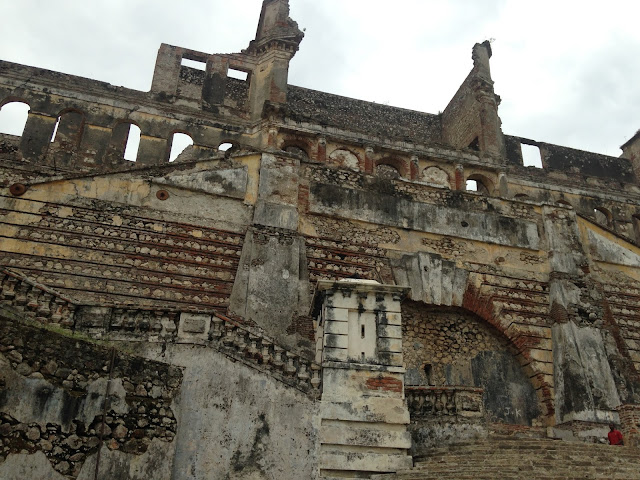
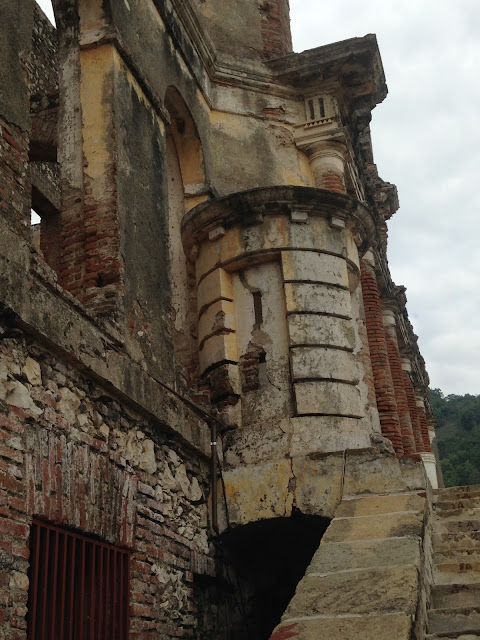
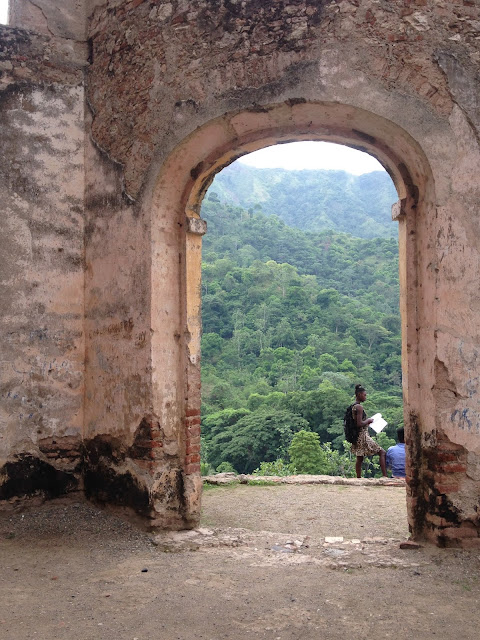
Christophe wanted to build a palace to rival Versailles, complete with gardens. His magnificent creation was damaged in the earthquake of 1842 and abandoned. What we saw today was a palace of brick and stone, with lovely arched doorways and windows and fine views of the mountains all around. They had a hospital and printing press and a place to greet international visitors. Christophe corresponded with heads of state including the Czar of Russia. We went in the morning and the air was cool. There were half a dozen young Haitians studying their homework; one girl working on chemistry problems of all things. No other humans invaded the grand space and we wandered from room to room, mouths hanging open and cell phone cameras flashing. If you are friends with my daughter Sienna on Facebook you can see more photos than I've included here.
Leaving the palace, whose name Sans Souci means "no worries", we climbed back into the van for another "off road adventure" Haitian style. Picture driving up a stoned road with switchbacks for 20 minutes, then arriving at a "way-station" where you meet your horse and guide for the last push up the mountain to the Citadelle. Being warned by Tim and Mimi Baker, who have done this before, I was prepared for this! The guides instructed us to lean forward on the ascent and backward on the descent. Right. And dont fall off when the horse shifts his weight to stop for bodily necessities! We climbed for 25 minutes, up and up and up. The road was well maintained, restored during Jean Claude Duvaliers administration, we were told. We saw several people working on it today. Ispan is the government ministry responsible for maintaining the historical monuments of Haiti, and as far as I can tell they are doing a good job.
Sienna is reading the Game of Thrones, and as we walked and climbed through the Citadelle today she remarked how it seemed similar to the old french castles she saw in Europe last year. Rows of cannons looking out through windows called "murder windows" (I dont remember the french name!). A grand aqueduct system built by the Haitians that still functions today to collect water and bring it down the mountain. At one time 6000 people lived at the Citadelle, and we saw the giant bread ovens used to prepare food for so many.
After Haitian independence, Jean Jacques Dessalines was the ruler of Haiti, similar to our George Washington, the guide told us. Sadly, Dessalines was assassinated by Haitians. Christophe and Alexandre Petion both wanted to rule Haiti after that. Christophe ruled in the north and Petion in the south. We now have Petionville, a city near Port au Prince. Christophe apparently suffered a stroke,leaving him partly paralyzed on the left side. When Petion heard that he sent troops to conquer the north and Sans Souci. Apparently this is the reason Christophe shot himself at Sans Souci, to avoid the disgrace. We stood in the room where this happened, as Maurice described for us the sad tale. Looking up at the majestic structure, I felt the loss of the dream of this man and thought about the structures man builds to show off his strength and power, which all come to naught in the end.
After climbing through more chambers, batteries, and vast empty rooms we rested at the top where we could see the mountains all around us and the drawbridge below. Maurice was patient with our many questions and was happy, I think, to be giving his tour in Kreyol. Very few people, even Haitians, ask for the tour in Kreyol. "They all want to speak in French", he told us. We talked about Kreyol being an oral language only until about 30 years ago. Now the Haitian children learn Kreyol AND French and English in school, which we all agreed is wonderful. There is a great need for more schoolbooks in Kreyol. Pas Ti Pas, the Haitian expression for "little by little"
We also agreed that Haiti's greatest asset is her young people. He described Sienna as a "citizen of the world" which is a great compliment.
Descending down the mountain on horseback was mildly alarming, especially when the horse wanted to catch up with his "lady friend in front", the guide told me. He put me and my horse in front after that, so no more funny business.
Tipping is always confusing in Haiti, as I never know how much is fair. Fortunately I have learned to ask other Haitians this important question, so Maurice had prepared me and I gave each of our horse guides $5. There were three of them. The first man quietly said to me, "you can give me $10, if you want, I wont tell the others."
Back into the van again, and it was only 12:30 PM, and still blessedly cool. Maurice took us to Lakay Lakou, which he is creating as a "cultural center" in his village of Milot. Arriving there, on the rooftop we were greeted by his wife with a bowl of fresh water and a bar of soap to wash our hands. Se magnifik! Lunch prepared graciously by Madame Innocent (a fine name) included carrots, potatoes, some type of green beans, onions, and tomatoes, all directly from her garden. Chicken, killed that day she told us. Picliz, Very Hot! Brown rice. For dessert, mango and cashew, the fruit of the same tree that gives us cashew nuts. It tastes like bread pudding, absolutely delicious. Again from their garden. And finally, coffee, ground from their own beans from their own tree. Hows that for Haitian immersion?
Sad to leave this welcoming couple and their obvious love for Haiti, we climbed again into the van at about 3:00, to head for our hotel, Cormier Plage. Again a mountain road, this one narrow, unpaved, through back country not obviously inhabited by anyone, much less a resort hotel? Just sit back and enjoy the process, I have learned to tell myself. What comes next will be even more wonderful than what you just left behind you. Of course, what happens to a fifty something year old woman after a fine lunch with two cups of coffee when she rides on a bouncy road for thirty minutes? You know what Im talking about. I was about to ask for an old fashioned stop alongside the road when we arrived at our hotel. Another botanical paradise, rivaling anything I saw in Hawaii. Our room is beachside, and we have all evening and tomorrow morning until noon to enjoy it.
Truly I must pinch myself, or at least write all this down to preserve these memories.
Sienna and I promised each other we will someday return to magical Cap Haitian and its treasures.
Susan Nelson
Wednesday, May 27, 2015
VOYAGE Day #4
Today we traveled to Cap Haitien via the Sans Souci bus. Speaking
Kreyol is a huge help with understanding "check your bag over there" and
"here is the waiting room" and "the bus leaves in 30 minutes". We did
NOT realize we had assigned seats, however, as there were no visible
signs or numbered seat designations, only Haitians asking us to please
move out of their seat! A helpful woman showed us where to sit, and off
we went, pulling out of the station promptly at 9:05 am.
The bus, to our pleased surprise, was a large comfortable
AIR-CONDITIONED affair like any tour bus in the US. Complete with TV
screen, playing a Haitian soap opera, but minus the bathroom. We
stopped along the road at one point, in the countryside, and a woman
took her small daughter off the bus briefly. I realized that was a
bathroom stop and hoped it would not be the only option, as it is a six
hour bus ride to Cap Haitian! (Okap).
Reflecting on our progress north through Haiti, I asked myself which type of road do I prefer? A paved road that curves and twists up the mountain? Or a straight UNPAVED road? Once we got about 50 miles out of Port au Prince, those were the two choices. I figured the pavement ran out in St Marc and they hadn't gotten around to repaving the northern part of the highway yet. We did see a few road crews at work, with heavy machinery in evidence, so perhaps the road to Okap will be better next time. The unpaved road is gravel and filled with holes, some of them 12 inches deep and 3 feet across. The driver is obviously experienced and moves from one side of the road to the other in order to avoid the deepest ones. Like Mark Twain navigating the Mississippi, I thought. Careful drinking from your water bottle because you might chip a tooth on the next bounce. I think I have bruises on my back from banging into the seat over and over, despite the cushions. The driver blared his horn at every blind curve to warn oncomers "Nou La!". We're here! This meant loud horn blasts every 30 seconds or so, for the better part of 3 HOURS! May I observe that "personal space" as defined by Haitian bus and truck drivers, has a different meaning than we Americans are used to. Our travel agent had advised us to "sit on the left side of the bus, you'll see better.". The better to see the oncoming Mack trucks!
Mercifully there was a 30 minute stop halfway, for bathroom break and lunch break, in a roadside station built just for that purpose.
Back on the road, we see miles and miles of hilly countryside, most of it looks farmed. Who owns all that land, I wonder? The sun is so bright I need my sunglasses, even through tinted windows. There are rare signs of human dwellings or buildings, other than the omnipresent BANK-LOTO buildings one sees everywhere in Haiti. Concrete buildings the size of a Texas outhouse, with Pere Eternel (Eternal Father) often painted brightly on the side. No houses or buildings to speak of for miles, then there is a BANK LOTO building. Apparently every community in Haiti has one? Then there are the groups of school children in their uniforms, usually 10 at once, walking along the highway by the dozens and dozens. There must be schools somewhere hidden in the plaintain groves down the hillside. Occasionally I see a half finished concrete dwelling, empty now, with arched doorways and windows and a 12x12 pile of cement rubble in the dirt yard. There are hundreds of these in Haiti as well, and they all look the same.
Other Haitian mysteries include: how can a woman carry what looks like 50 pounds on her head without holding on to it? The Haitians lay their clean laundry out to dry on the roadside, on what looks to me like bare dirt. How do they keep their clothes clean?
Arriving at the bus station in Okap, we were quickly greeted by our taxi driver and drove through the "City of Independence" to our Hotel Roi Christophe.
Henri Christophe was one of the leaders of the Haitian revolt against the French, and built himself a fortress called the Citadel. He declared himself king and built a palace called Sans Souci ("without worries"). We visit both places tomorrow. I noted the city of Cap Haitien seems to have a slightly more permanent feel to it than the crumbling chaos that is Port au Prince. There are actual storefronts here, with doors instead of huge locked metal gates. The hotel entrance is open to the street, and a cool breeze has been our company since we arrived. Gorgeous mahogany furniture fills the rooms and hallways, and there is the usual profusion of colorful botanic life. Sienna and I enjoyed passion fruit ice cream (intense flavor, like nothing I've ever tasted before)
and then our feet in the swimming pool before retiring to our room. Truly a luxury vacation.
Subscribe to:
Posts (Atom)